Investment in the Euro Area: Why Has It Been So Weak?
IMF Blog, February 19, 2015
Source details
- Canonical URL
- Investment in the Euro Area: Why Has It Been So Weak?
Other formats
Bibliographic details
- Authors: Bergljot Bjrnson Barkbu, S Pelin Berkmen, Hanni Schlermann
- Published: February 19, 2015
Overview
- Authors: Bergljot Bjørnson Barkbu, S. Pelin Berkmen, Hanni Schölermann
- Date: February 19, 2015
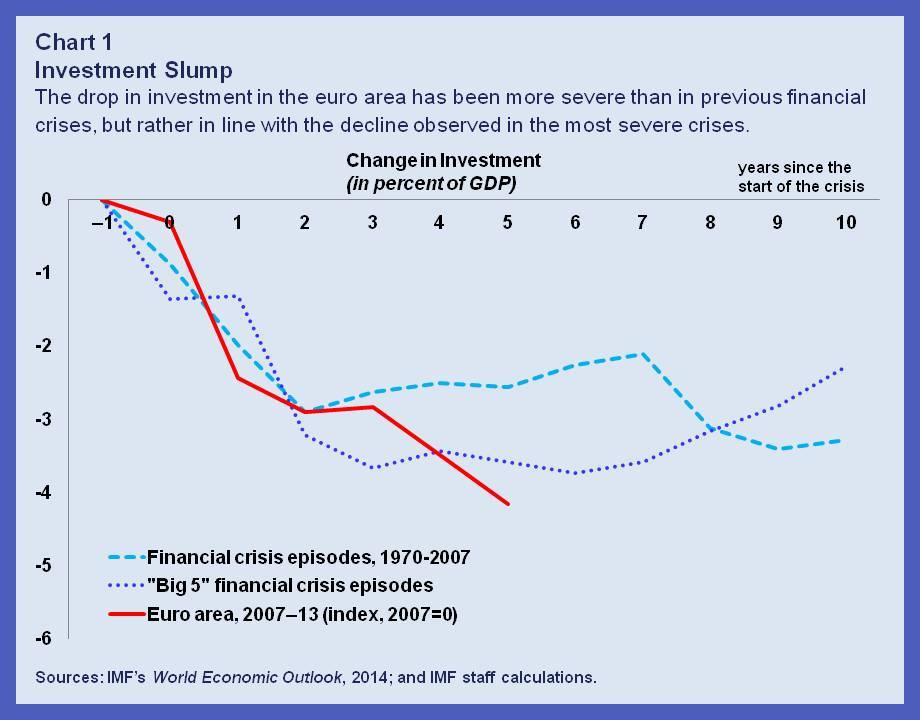
- Core finding: Investment in the euro area, particularly private non-residential investment, has not recovered since the onset of the global financial crisis and fell more drastically than in many prior financial crises.
Key drivers of weak investment
- Low or negative growth:
- Creates a "Catch 22": investment is low because firms lack demand, and growth is weak partly because investment is low.
- Particularly pronounced in Spain, where changes in real GDP explain variation in investment well.
- Crisis legacies that further depress investment:
- High corporate leverage / indebtedness impairs creditworthiness and borrowing ability (noted for Portugal, Italy, France).
- Policy uncertainty reduces firms' willingness to invest (important in Spain, Italy, Greece, Ireland, and the euro area as a whole).
- Borrowing constraints and difficult access to bank finance (noted for Italy and Portugal).
- Financial constraints vs. cash financing: some firms use internal cash flows to finance investment, with higher cash inflows associated with more investment in Spain and Germany.
Quantitative findings
- Cumulative unexplained shortfall in investment (difference between investment predicted by output changes alone and actual level of investment):
- Ranges between 3 and 6 percent of GDP when only output changes are considered.
- Narrows to ½ -2 percent of GDP when additional factors are included (uncertainty, indebtedness, borrowing costs, cash buffers, financial constraints).
- Country example:
- In Italy and Portugal, the unexplained shortfall declines from about 6 percent of GDP to less than 1 percent of GDP when accounting for the additional factors.
Implications and policy recommendations
- Short-term demand support:
- Investment should pick up as the recovery strengthens.
- Continued accommodative monetary policy and the use of available fiscal space at the national level can help support investment by raising current demand.
- Address crisis legacies and financial impediments:
- Dealing with corporate debt overhang and high non-performing loans should be a priority, as indebtedness impedes investment.
- Improve firms’ access to capital and lower borrowing costs.
- Complete the banking union and build a capital markets union to boost investment prospects.
- Structural and regulatory reforms:
- Make financial intermediation more effective.
- Implement more flexible labor and product markets.
- Undertake reforms to improve the business environment to raise growth expectations and reduce policy uncertainty.
- Overall approach:
- A comprehensive policy effort to reduce policy uncertainty, revive "animal spirits," and contribute to a sustained recovery in investment.
Source: Investment in the Euro Area: Why Has It Been So Weak? — https://www.imf.org/en/blogs/articles/2015/02/19/investment-in-the-euro-area-why-has-it-been-so-weak